Celebrate National Night Out on August 3rd
|
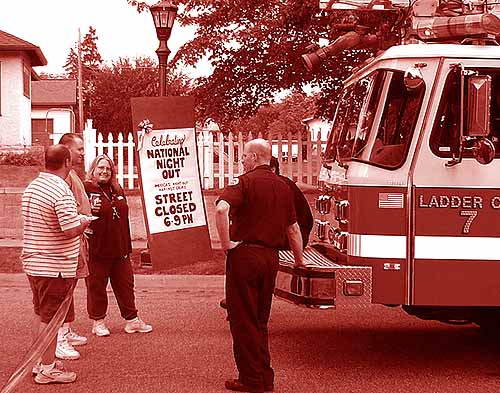
Neighbors on Clarence Street celebrated
National Night Out in 2003 with a street party that had plenty of food
and a visit by a fire engine. Photo by Nancy Larson
|
Celebrate National Night Out on Tuesday August 3,
2004 with your neighbors and friends. There are many things a group of
neighbors can do. Some neighborhood groups and block clubs are planning
to have a neighborhood barbecue, a potluck, an ice cream social, a band
playing music or a volleyball game.
Plan to spend the evening getting to know your
neighbors. National Night Out is designed to heighten crime and
drug prevention awareness, generate support for and participation in
local anti-crime programs, strengthen neighborhood spirit and
police-community partnerships, and send a message to criminals letting
them know that neighborhoods are organized and fighting back.
Join 30 million other people in more than 9,000
communities nation-wide in a variety of events and activities.
Let’s make this year’s National Night Out even bigger than
last year!
Here is a list of some Dayton’s Bluff National Night Out
events:
1st Lutheran Church, 464 Maria
5th Street East between Mounds Blvd and Maria, 6:00 p.m.
Bethlehem Lutheran Church, Margaret and Forest
Clarence between Point Douglas and McLean
Conway between Arcade and Mendota
Fremont between Atlantic and Johnson Parkway
Indian Mounds Park, Earl and Mounds Blvd
Margaret between Johnson Pkwy and Atlantic
Margaret Recreation Center, 1109 Margaret, 6:00 p.m.
Maria and Euclid
Reaney between Forest and Cypress
Swede Hollow Park, Greenbrier and Margaret
Wilson between Mendota and Forest
All events start at 6:30 p.m. (unless otherwise noted) and
end around 8:30 p.m. Bring something to share and
attend an event near your home. Call Karin at (651) 772-2075 for more
information or if you want to hold an event in your Dayton’s Bluff
Neighborhood.
Native American Family and Kinship
By Nachee Lee, Executive
Director, Dayton’s Bluff Community Council
It was my good fortune to have met Mr. John Poupart who
works for the American Indian Policy Center. My encounter with
Mr. Poupart enlightens and enriches my life view and cultural
philosophy. He shared and provided me great knowledge about his
people and his passion to passing on knowledge about the Native
American people to others.
John kindly gave me a handbook that he and the Policy
Center had written. The handbook talks about bridging Native
American culture with the mainstream culture. After reading it, I
find the Native American family and kinship system fascinating and
inspiring, and I want to share it briefly with the Dayton’s Bluff
community.
For the Native American people, families, clans and tribes
are very important. Native American families are usually
extended, which includes family members such as aunts, uncles,
grandparents, and multiple households. Therefore, child rearing
is very important to the families and community. It is considered
and valued as a tribal and community responsibility, and the child is
shared among all family members. Traditionally, Native American
parenting was considered a sacred obligation and those parents who
neglect and abuse their children could be banished from families and
clans.
Most of the time, traditional Native American children
learned their traditional values orally and through observation of
ceremonies and traditional rituals. Native American traditional
values and customs are vital to their way of life. They, elders,
believed that for them to retain their important traditional values and
customs they must connect with their children through oral language and
social roles. To a certain extent, it appears to me that this is
somewhat similar to my own culture where traditional values and customs
are passed onto children through social roles and ritual
practices. It also appears to me that these methods are best for
them, because they do not have a written language.
For the Native American, traditional roles are an
important part of their family and kinship system. Sadly,
many of their traditional roles have changed due to their acculturation
with the mainstream way of life. Many feel, though they are
acculturating with the mainstream way of life, they still continue to
maintain and practice their traditional roles and rituals. According to
John, though Native Americans are trying to participate in the
mainstream culture, most of them are struggling to retain their native
identity.
In my deepest opinion, if by any means possible, our current
society can operate or function in somewhat similar to the Native
American family and kinship system, then I believe there might be less
chaos and breakdowns among families. To what I know, many family
breakdowns, to some extent, are due to what our society promotes,
individual achievers.
Please contact the Native American Family Center at
651-793-3803 or the American Indian Policy Center at 651-774-1728 on
the Eastside, if you are interested in learning more about the Native
Americans or are in need of their services.
Dayton's Bluff Community
Council board members needed!.
The Dayton’s Bluff Community Council would like to have
you on board
if you can attend two meetings per month, want to make a difference,
and like to meet other people.
Benefits of serving as a board member for the Dayton’s
Bluff
Community Council: Your voice and input counts; you have the
opportunity to network with other great people from the neighborhood;
you can learn about neighborhood issues and running a non-profit
organization; and it provides a great reference for future
opportunities.
Criteria for serving as a board member: You must be
at least 18
years old, live or own property or operate a business in Dayton’s
Bluff, care about improving the neighborhood, and have a great
smile.
The deadline for filing for the board is September 20, 2004.
Election for new board members is Monday, October 18, 2004.
If you are interested in coming on board or would like more
information, please contact Mr. Nachee Lee, Executive Director, at
651-772-2075 or visit www.daytonsbluff.org.
Join
Lyman Dayton’s birthday celebration
The newly formed Dayton’s Bluff Heritage and
Happiness Club recently announced what they hope will be the first of a
series of informal community celebrations.
The kick-off event will commemorate the birthday of Lyman
Dayton, whose early real estate holdings gave this community its name.
It will be held on Wednesday, August
25 between 6:30 and 8:00 p.m.
The celebration will take place on the grounds of what
used to be the Lyman and Maria Bates Dayton home, located in the empty
lot above Mounds Boulevard between 3rd Street and Conway.
It will be a potluck, so please bring a dish or two to
pass. You will also need to provide your own plates, blankets or
chairs, etc. People are encouraged to bring guitars or other
instruments for an impromptu talent show.
As a special incentive, you and your family will have a
chance to take a photo in front of a large model of the old Dayton
home. If there is interest, there may be a short discussion of the
lives of Lyman and Maria Dayton. There will also be a drawing for a few
Dayton’s Bluff historical items.
Grocery Give-Away
A Grocery Give-Away will take place on Saturday, August 21 from 10:30 a.m. to
noon at
Mounds Park United Methodist Church,
Euclid and Earl. Free produce, dry goods and bread items will be
given to anyone who can use them. No registration or sign-up is
necessary.
Sponsored by United Methodist churches on St. Paul's east side.
Munchkins
visit the Mounds Theatre
|
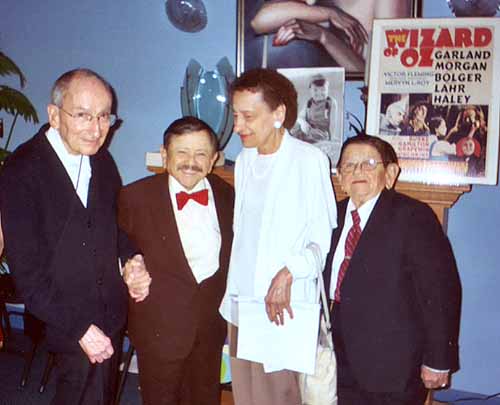
Two of the Munchkins from the 1939
motion picture Wizard of Oz
visited the Mounds Theatre on June 28th for an evening of storytelling,
singing and picture taking. Gordon “Porky” Lee from the Little Rascals was also
present. The event was sponsored by the Laurel and Hardy
Block-Heads Tent. Shown above (left to right): Joe Cosimini,
Munchkin Jerry Maren, Elsie Cosimini and Munchkin Karl
Slover. Photo by Greg Cosimini
|
A Community gathering for
our neighbors
First Lutheran Church, 463 Maria Avenue (one
block north of Metropolitan State University) will host a Town Hall
Meeting on Tuesday, August 31
from 6:30 to 8:30 p.m.
Plan to come to this community gathering for our neighbors
if you:
Want a more just and equitable world starting with
our own neighborhood and city.
Want to hear powerful ways to effect change in our
community on a number of issues, including: domestic violence, economic
development, and community policing.
Want a new way of practicing a public faith that
makes a difference in the world.
Join us for this gathering!
The agenda will include:
6:30 - 7:45 p.m. - a facilitated conversation about our
core values as citizens and people of faith.
7:45 - 8:00 p.m. – A public meeting with local public
officials to engage them in our work around domestic violence, economic
development, and community policing in St. Paul.
Be
your own boss - Start your own business
Have you ever wanted to start your own business? Or, have you
started one and are realizing that you need more education to make it
successful? If so, sign up for the Dayton’s Bluff Neighborhood
Entrepreneur Training and Support Program. This program helps start-up
and young businesses on the East Side. All East Side entrepreneurs are
welcome. East Seventh Street is a good place to locate your
business. There are a number of storefronts available now. Also check
out the Earl-Hudson area if you are looking for business space.
The next class will start in September 2004. Classroom
training lasts about 16 weeks and includes topics such as operations
management, marketing, financial management, and preparing a business
plan. In addition, the class provides approximately eight hours of
one-to-one assistance with creating a successful business. Those who
successfully complete the course and locate their businesses in target
neighborhoods are eligible for ongoing business support services.
Some of the businesses that people who took the course
have started include graphics, photography, food service, restoration
of wood furniture and works of art, custom floral design for weddings
and events, and exterior and interior painting. The course is sponsored
by the Dayton’s Bluff Community Council and the Neighborhood
Development Center. There is a small registration fee based on a
sliding fee scale. Class size is limited so get your application in
today.
Please call Karin at 772-2075 for more information or an
application.
Dayton's Bluff Take a Hike
There will be no Take a Hike in August but join us on September 4 at 10:30 a.m. in Indian
Mounds Park at Earl Street and Mounds Blvd. for the next hike.
For more info, call 776-0550.
Don't stop recycling!
Notice to the
Margaret and Atlantic construction area
You can recycle all summer long even though your street is
scheduled for construction. Set your materials close to the street in a
visible place. If our regular trucks cannot get through your street, we
will use a special smaller truck to collect your recycling. We may pick
up recycling on your street earlier or later than other streets in your
neighborhood or we may need to return the following morning to access
your street. Please have your recycling out on the regular alternating
Tuesdays by 7 a.m. and leave it out until noon the next day. If we miss
your recycling or if you have any questions, please call the Recycling
Hotline at (651) 222-SORT (7678).
You can also take your all your recycling materials to the
Vasko drop-off site, located at 309 Como Avenue (Como &
Minnehaha). Look for the large containers to the right just inside
Vasko’s gate. (651) 487-8546.
True confessions about
life "up north"
By Mary Petrie
Up north! That great Minnesotan escape: summer
explodes and we’re instantly top-heavy, the entire population edging
upward. Think of a shimmering calm lake, teeming with
fish. Think of the incredible landscapes – the complicated beauty
of the Boundary Waters, the towering and dense Chippewa National
Forest, the endless channels of rivers and lakes all calling to the
hot, weary citizens of the city. Up north!
Like thousands of other families, ours will make this trek
a couple of times, renting a cabin here or staying with friends
there. We’ll fish, hike, swim, and take in the
scenery. The children will track chipmunks and squeal every time
they see a deer. Stryker will catch beetles and snakes; Scarlett
has plans for a bark and acorn collection. The baby will toddle
in tall grasses, au natural. We’re perfect tourist ad fodder.
The one glitch to this idyllic scenario: I hate nature.
Yes, it’s true. Lakes are, well, wet. There’s
all that sand to contend with—scratchy in between my toes and in
someone’s eye at least once. Think wood ticks, leeches, and
a variety of other parasitic creatures waiting to suck blood or
dispense disease. Don’t bats live outdoors? How about that
walk through the woods: excuse me, where are we going?
Walking without distinct destination is not exactly my idea of
entertainment. Aren’t squirrels actually rats with tails?
How about that national forest: is there an espresso stand hidden
in there somewhere? Poison ivy is not all that
attractive. And all those deer look alike to me. So I’ve
seen a few. I’m done.
Don’t get me wrong – I’ve done everything shy of depth
therapy for urban girls to repress, deny, turnabout, and overcome this
disdain for the great outdoors. I’ve gamely climbed into
boats and taken up cross-country skis. These hands have handled
snakes, fish, worms, and hot-bellied toads. I’ve hiked my share
of northern trails and stifled a yawn while looking at some such leaf
or bird for the millionth time. Part of my hard-earned dollar
goes to the Sierra Club and I’m the first one to jump on just about any
environmental bandwagon. My front lawn has had signs for Green
Party candidates.
Perhaps this summer marked the beginning of my ‘older and
wise’ phase, because I’ve given up the stabs at change.
Instead, I’m embracing my contradictions and character flaws with zeal.
No, I don’t like lakes or cabins or walks in the wood. Give me
strong coffee, a bookstore and a paved street where I can walk in
strappy sandals, thank you.
I marked this change of attitude in June, while at Finns N
Feather Resort, just outside of Bemidji. My conversion
occurred while I was sitting in a comfy armchair, safely indoors,
reading the New York Times. Our eight-year-old son asked me
if I wanted to go fishing. Fishing? My feet were propped
up. I had an iced drink at my side. There were book reviews
to be read, articles on the nightlife of the Palm Beach elite.
Not only did I decidedly not want to go fishing at that precise moment,
I had one of those ‘Aha’ realizations: I would never go fishing
again!
I said those sweet words of freedom out loud:
“Stryker, I’m never going fishing again!”
His face fell.
I refused to succumb to that sort of pressure. “Go ask
your father,” I commanded. My limitations were clear and I
accepted them. He should too! This was Daddy’s duty.
I mobilized my own troops. I gathered Scarlett,
beach towels, books, snacks, tanning oil, lemon (for hair), nail polish
and made a bee-line for the heated pool—complete with shaded tables and
long backed lounging chairs and vending machines. My sixteen year
old self re-emerged for a few glorious hours. I soaked in all
those cancerous rays, drank diet soda and ate corn chips. I
purchased food-like objects from the machines and licked the fake
chocolate off my fingers.
Normally goaded into eating veggies and putting on
sunscreen, Scarlett could not believe her good luck. She was a
willing partner in crime. We painted our toenails and swore
never, ever to be without pretty clothes or sufficient hair care
products again.
Later on that night, a summer storm blew through.
Rain came down in straight sheets, rocketing onto the water. Even
I had to admit it was pretty. Our whole family stood in the
living room window and watched the sky.
John grabbed the umbrellas and rain gear. He
was all action – let’s take a stroll in the rain, he suggested.
Let’s get a feel for the storm’s power! Stryker already had his
boots on.
“I’m allergic to weather,” Scarlett announced, arms folded
and face set.
I hugged her. “That’s my girl!”
True happiness is the city skyline on the trip’s return
and seeing how thick, how strong, that family blood can run.
Mary Petrie is a Mounds Park
resident who will be writing about life in the neighborhood and ways to
improve the quality of family life.
Dayton's Bluff
Neighborhood Clean Up
On Saturday, September 11, 2004 the
Dayton’s Bluff Annual Neighborhood Clean Up will be held from 9:00 a.m.
to noon at Ray Anderson & Sons north of East 7th Street at the end
of Atlantic. More information about the Clean Up will be in the
next issue of the Forum. Volunteers are needed to help with the Clean
Up. There will be limited item pick up for Seniors Citizens with
no means of transportation. Call Karin at 651-772-2075 to volunteer or
for more information.
DO NOT BRING APPLIANCES TO THE CLEAN UP. On Monday,
Sept. 13 J.R.’s Appliance Disposal will be doing a special curbside
appliance pick up in Dayton’s Bluff. The cost is $25.00 for one
appliance, plus $10.00 for each additional appliance and an additional
$10.00 for each air conditioner. Call J.R.’s and sign up for this
special pick up. They will let you know the cost for your
appliances. Then have your old appliances on the curb on
September 13th. Call Joan at J.R.’s: 651-454-9215.
One
hundred years ago
|
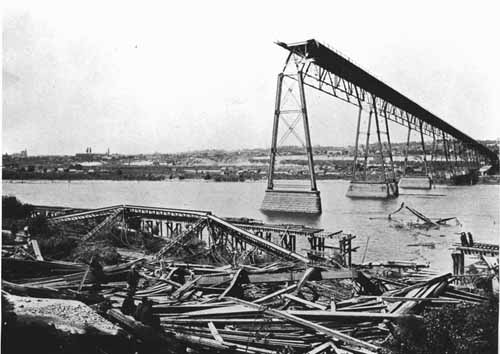
Photo Courtesy Minnesota Historical Society
|
“Death Rides a Cyclonic Gale,” read the
front-page headline of the August 21, 1904 St Paul Globe.
On Saturday August 20, 1904 at about 9:00 p.m. St Paul
found itself in the path of a fierce F3 tornado. Winds topping
180 miles per hour left a swath of destruction and devastation from
Cherokee Heights on the West Side straight through Downtown and up
Payne Ave, hitting the East Side particularly hard.
At least three people were killed and hundreds more
injured. Innumerable businesses and homes where damaged or
destroyed, including the High Bridge (above), and huge numbers of trees
all over the city were uprooted. This month marks the one
hundredth anniversary of this horrific storm.
August at the Mounds
Theatre
Saturday August 7,
2:00 p.m. – Kinetic Playground: A new tradition in dance
showcasing youth dance artists from Ballareteatro Dance Theatre, CAAM
Chinese Dance Theater, Riverbend Dance Arts and Youth Dance Ensemble.
Tickets: $10.
Thursday August 12,
7:30 p.m. – Vicky Emerson: Join this award winning
singer/songwriter/pianist and her band for a summer evening of soulful
singing, wonderful music and humorous stories. Don’t miss this chance
to hear Vicky debut songs from her upcoming album! Tickets: $8 in
advance; $10 at the door.
Saturday August 14,
7:00 p.m. – “Do You Remember Darla?”: This is a benefit fundraiser for
Mounds Theatre. Come see “your mama’s burlesque” starring Darla and The
Darla Dames with guest performers Illumination Troupe (colored light
twirlers), local comedian Vincente Luna and dancer Bobby Wilson.
Tickets: $7 general; $5 seniors.
Thursday August 19
to Sunday August 22 – “Charlotte’s Web”: The Mounds Theatre
Performing Arts Youth Conservatory presents a live all-youth cast
production of this heart-warming novel. Aug. 19, 20 & 21 – 7:00
p.m.; Aug. 21 & 22 – 2:00 p.m.; Tickets: $5 adults; $3 youth (16
and under).
Friday August 27 to
Sunday August 29 – “KUV LEEJ NIAM” (My Mother): A new film by
Moua Lee presented in DVD format on a full size movie screen in Hmong
with English subtitles. Aug 27 & 28 – 7:00 p.m.; Aug. 29 – 2:00;
Tickets: $5 adult; $3 youth (12 and under).
For more information call the Mounds Theatre at (651)
772-2253 or visit www.moundstheatre.org.
Grand
Excursion 2004 arrives in Saint Paul
|
|
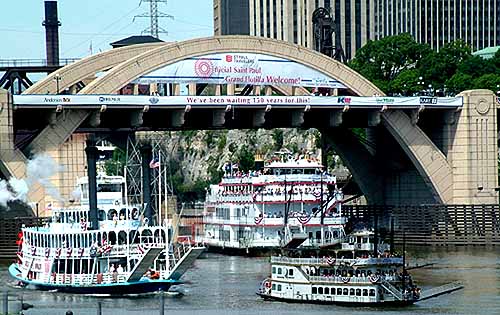
Photo
collage by Toni Thomas
After 150 years the second
Grand Excursion reached Saint Paul on July 3, 2004.
Unfortunately, as a Letter to the Editor points out on page 5, there
wasn’t much to see for the people waiting to view it from Mounds
Park.
|
A
Short History of Dayton's Bluff - By Steve Trimble
Chapter 1: The Beginnings
The first humans to live in what we now call Dayton’s Bluff were
probably hunting bands thought to have arrived around 12,000 years ago.
They were probably following the large mammals that were grazing on the
lush vegetation that sprang up as glaciers receded.
If they paused to stand in today’s Indian Mounds Park they
would look out across a huge river that archaeologists named the River
Warren. It was fed by a massive body of glacial water called Lake
Agassiz and filled the area to the top of the bluffs. These first
inhabitants would have heard the roaring sounds of a giant waterfall
that spanned the distance between the modern state capital area and the
southern edge of the Robert Street Bridge.
As the walls of ice retreated, the region first
developed into a “tundra” that offered food for animals and birds.
Herds of mammoth, caribou and bison came to graze and drink from the
turbulent waters or, like the giant beavers, to swim and feed in
marshlands.
These “paleo-Indians” as archaeologists have labeled them,
surely found the area surrounding today’s Dayton’s Bluff an excellent
spot for living and hunting. It contained a variety of eco-niches, such
as prairies, wet prairies, and river bottoms. We know little about them
and the only evidence of their existence here consists of a few
uncovered projectile points.
During the next two or three thousand years the landscape
continued to be altered as the climate changed. As the waters
receded and the temperature moderated, the more familiar oak savannah
and oak-hickory forests began to move into the prairie along the river
near St. Paul.
The Mound Builders
Around 2,000 years ago a new group appeared and dwelt upon
the land for perhaps a few hundred years and then disappeared. We can
note their presence by their burial mounds which yet lie on top of the
shining white sandstone cliffs, in a spot known as Indian Mounds
Park.
Today they are called the Hopewell Culture, often referred
to as the mound builders, because they constructed thousand of these
earthen edifices up and down the Ohio and Mississippi Rivers. The
massive size of some of the downriver structures is evidence that there
was a structured kind of labor among the group.
While earlier inhabitants had been hunters and
gatherers who frequently moved to stay near their game, the Hopewell
culture developed permanent settlements. According to one archeologist
the “Hopewellian peoples” were among the first fully committed
agriculturalists.
Farming became a central focus of their life and not just
as a supplement to hunting and gathering. These earliest farming
systems were based on local seed-bearing annuals. Sunflowers, squash,
beans, and marsh elder, a form of barley, were among the most important
plants. Maize (the predecessor of today’s corn) become a staple a few
centuries later and replaced most of the earlier indigenous crops.
From what can be determined or at least theorized, the
mound builders had a highly structured society that included priests
and artists. Two of the excavated mounds had eight stone containers
made of limestone slabs set upright. The people were often buried with
artifacts such as stone knives, copper axes, pipes carved into a
variety of forms (often those of animals), pottery vessels, and
ornaments made of copper and shell.
The mounds varied in size. The largest one in Dayton’s
Bluff was twelve feet high and sixty feet in diameter. Some artifacts
were made of material not available locally, and some originated
hundreds of miles away. There was black volcanic glass from
northwestern Wyoming, copper from the Lake Superior area, mica from the
Appalachian Mountains, and marine shell from salt-water oceans. These
materials reveal Hopewell involvement in an extensive trade network
The contents of the burial mounds revealed many aspects of the
Hopewell society and suggest that it was fairly structured. They
contain carved animals on utensils and pottery used for feasts and
religious rituals. This reflected the harmony and dependence these
people had for the natural world.
In addition, it seems certain that they were part of a
widespread trading network. The establishment of trade routes can be
seen in the materials they had that came from as far away as the Rocky
Mountains, the Atlantic Ocean, and the Gulf of Mexico. After 400 A. D.,
for reasons not fully understood, the Hopewell culture faded away. The
six burial sites in Indian Mounds Park are the oldest remaining
structures constructed in our neighborhood.
Dakota Settlement
About 500 years ago the Mdewakanton band of the
eastern Dakota began to live near the banks of the Mississippi. The
Dakota - sometimes called the Sioux - had been pushed out of northern
Minnesota by the Ojibway. While most migrated to the Great Plains area,
four or five bands of the Mdewakanton chose to settle along the banks
of the Mississippi and Minnesota Rivers.
One group settled in today’s Dayton’s Bluff area in a
location they called “Im-in-jus-ka” which translates into “white
cliffs.” The village was located on the east bank of the
Mississippi. Kaposia, as it came to be called, moved around a bit. It
was sometimes at the outlet of Phalen Creek and other times near
today’s Pig’s Eye Lake just south of today’s Mounds Park.
Dakota life could be described as cyclical, varying with
the recurrent seasons. Between January and spring, the villagers,
probably numbering around 400, lived in the oak groves under the bluff.
By mid-March, they were usually ready for maple sugaring, done mostly
by the women, and the male-oriented muskrat hunting. Sugar bushing
lasted a month after which the women returned to the permanent
site.
In May the women would tend to the children and plant
corn, pumpkins, squash and beans in the flood plain of the Mississippi.
In June they would often break into smaller groups for berry and herb
gathering. The men would fish, clam and trap and sometimes leave for
buffalo hunting farther west.
By September there was the harvest and the men continued
hunting small game. In the fall, the women, sometimes accompanied by
men, would go cranberry picking and gathered wild rice, often going as
far away as Mille Lacs. The winter was a time of indoor work and, if
harvests had been sparse, a time of deprivation. With the arrival of
spring, the cycle began again.
It was probably not long until a few adventurous Dakota
proceeded to investigate a deep cave at the base of the cliff.
Embarking with a canoe on the pond within the cave, they would have
ventured into a deep darkness, lit only by a few sputtering bark
torches. At some point, they began to call the cave “Waken Tipi” or
“House of the Spirits.”
It is highly probable that there were many carvings
of human figures, animals, birds and reptiles dug into the soft white
stone near the mouth of the cave. These were likely left by the mound
builders. Some of the Dakota may have added their own drawings to this
gallery of prehistoric Indian art. The story of this fabled cave will
lead to the first coming of the Europeans.
Earliest European Contact
The Dakota may actually have brought the first European to
this area. In 1680 the captured Belgian explorer and missionary Father
Hennepin was brought to a site many think was near the Phalen Creek
outlet into the Mississippi. At that time the land here was claimed by
the French government.
“Having arrived on the nineteenth day of our navigation,”
Hennepin commented in his diary, “five leagues below St. Antoine’s
Falls, the Indians landed us in a bay, broke our canoes to pieces and
secreted their own in the reeds.”
After the Seven Years Wars the French ceded
the land to England in the treaty of 1763. Eager to find out the nature
of the land they saw as their colonial possession, the English
dispatched Jonathan Carver to visit. When he arrived at the bend in the
Mississippi, the Dakota showed him the mysterious cave near their
settlement.
Carver describes the event in a book he later published.
On Nov 14, 1766, he said he came to “a remarkable cave of amazing depth
that the Indians called Wakan-Teebee.” As was often the case with
European explorers, he decided to name it after himself.
Jonathan
Carver Visits a Cave
“November 14, 1766. This day arrived to the great stone
cavecalled by the Nadowessee Waukon Teebee, or in English the house of
the spirits. This cave I found to be a great curiosity, in a rocky
mountain just by the bank of the river. The mouth of the cave... the
entrance about ten feet broad and three feet high.
I went in and measured the room upwards of thirty feet
broad, and about sixty feet from the entrance of the cave where I came
to a lake. As ’twas dark I could not find out the bigness.... The roof
was about 20 feet high at the greatest elevation, the bottom clean
white sand a little descending to the water from the mouth. I cast a
stone which I could hear fall at a distance and with a strange hollow
sound. I tasted of this water and found it to be very good.
The Indians say that several have attempted to go
with a light and a canoe on this water but have been deterred by some
frightful appearances of light shining at a distance and strange sounds
which make them give it the name Waukon Teebee...
The rock at the entrance of the cave is of lightish gray
colour and very soft like the grit of a grindstone. I found many
strange heiroglyphycks cut in the stone some of which was very ancient
and grown over with moss. On the stone I marked the arms of the king of
England.
Near the cave is the burying place of the
Mottobauntoway band of the Nadowessee. A few months before I came here
dyed and was buried the chief of this band. I went to see the grave. It
is impossible for me to describe all the hieroryglyphicks and
significant marks of regard and distinction this people had paid to the
memory of this deceased grandee...”
Jonathan Carver
May 1, 1767
Dayton's
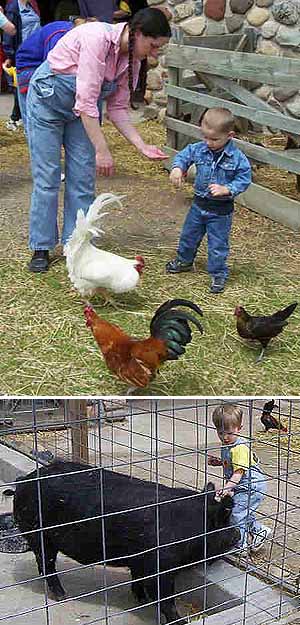
Bluff ECFE field trip to Dodge Farm
On a beautiful day
in a spring which was stingy with beautiful days, parents and their
young children ages one to five boarded a big yellow school bus
sponsored by the Early Childhood Family Education (ECFE) program at
Dayton’s Bluff School for a trip to Dodge Farm. On the way the
group stopped for lunch and time to play at Marthaler Park.
Children of all ages and differing physical abilities enjoyed climbing,
running, sliding, and socializing with each other while parents kept
watch. They then reboarded the bus and continued on to the farm
where they divided into small groups for guided tours of farm
attractions.
The tour guides helped children hold baby chicks, pet
loudly squealing piglets, jump in the hayloft, shell corn to feed to
the chickens, and much more. Goats, cows, pigs, ponies and sheep gave
kids an up-close look at animal life that most of them do not see much
of in their daily lives. Some of them looked for, and were
disappointed not to find, cats. The farm added a real life
dimension to the farm curriculum which kids’ classes had explored in
their Early Childhood Family Education Classes in the preceding weeks.
Early Childhood Family Education classes ended for the
2003-2004 school year on June 9th, but they will resume again in
September. Brochures describing all St. Paul Early Childhood
Family Education programming for 2004-2005 will be available in St.
Paul Public libraries in early August and will also be posted online at
www.spps.org/ecfe. If you are interested in having fun while
supporting the growth and development of your children from birth to
school entrance, find a copy of the brochure and register.
|
 |
Elder's Wisdom, Children's
Song - Elizabeth Lucio
This is the last in the series of articles about the
Elder’s Wisdom, Children’s Song project under the leadership of Larry
Long at Dayton’s Bluff Elementary School. The students worked on
the state standards for speaking, listening, reading and writing during
the process. Larry Long led the children as they practiced
interviewing skills and talked about the importance of learning and
respecting the elders of the community.
Interview
My name is Elizabeth Lucio. I was born in Mexico on May
13, 1969. My parents were Marco Lucia and Julio Garcia. There are 6
children in my family, 3 boys and 3 girls.
We moved to the United States when I was 3 years old. We
lived in the Rio Grande Valley. My family moved to the United States to
give us a better life. We moved to find work. I lived in Texas for 25
years. When I first moved to Minnesota I wanted to go back to Texas so
badly, but now Minnesota is my place.
We used to go back to Mexico every weekend to see my
relatives. Now I only have two uncles who live in Mexico. Holidays were
very special in Mexico. My grandmother would make tamales and cherones.
We used to wake up on Christmas morning and a bag of candy would be by
our heads.
My grandmother, Maria, was really funny lady. She would
always welcome us at her house. We never got in trouble with her. One
time when all of the family was over at our house I was trying to hide
my new guitar so none of my cousins would play it. I kept putting it in
different places but they always would find it. I decided to put it by
my Grandma’s chair because she wouldn’t let anyone touch it. It was
like it was hidden in a closet but it was out in the open. Everything
changed when she died.
When my parents separated it was very hard for me. My dad
went out to get something and my mom said, “This is our opportunity to
leave.” She called a taxi and we could only take what we had on. I
didn’t know what was happening. I had to start 6th grade with only 2
changes of clothes.
Education has always been important to me. My words of
advice are: Keep up the good work. Work hard and finish school. Go to
college.
Song
I was born in Mexico
Came to Texas at three years old
With my mother and my dad
Along the border of the Rio Grande
(Chorus)
Hey, hey, hey
Keep on living
My mother had six kids
Took care of them is what she did
My father was the best
Mechanic in the southwest
(Chorus)
To live is to forgive
To forgive is to live
Every year we would go
To my Grandma¹s house in Mexico
Whole family spent Christmas there
Bags of candy everywhere
(Chorus)
At thirteen I heard my pa
Yelling at my ma
Even though he was good to me
My mom forced him to leave
(Chorus)
To live is to forgive
To forgive is to live
My brothers lived with my dad
The whole family was so sad
My sisters, mom, and I
On food stamps we survived
(Chorus)
To be a woman at age fifteen
A Quinceanera just for me
My father came with his best friend
The whole family together again
(Chorus)
To live is to forgive
To forgive is to live
After school work, work, work
From Shipley Donuts
to the Baptist church
To Minnesota we all came
To work, work, work every day
(Chorus)
Words & music by Ms. Alicia
Santi¹s 5th Grade Class of Dayton¹s Bluff Achievement Plus
Elementary School and Larry Long. Copyright Larry Long 2003 /BMI
East
Side School Supply Drive
As part of the National Night Out celebrations, the
Dayton’s Bluff District 4 Community Council and the other East Side
area district councils will collect “Back to School” supplies for East
Side public schools at each of our neighborhood events.
We are looking for your contribution of crayons,
notebooks, pens and pencils, notebook fillers, and other popular school
supplies to be allocated to needy East Side school children.
Contributors can bring school supplies to their neighborhood National
Night Out celebration, or during the entire month of August can leave
them at several drop locations in the neighborhood, including:
+ District 4 Community Council offices, 798 East 7th Street (at
Margaret)
+ Dayton’s Bluff Neighborhood Housing Services (NW Corner of East 7th
& Arcade)
+ North East Neighborhoods Development Corporation (basement American
Bank Building, NE corner of Prosperity & Maryland Avenues)
+ Downtowner Car Wash, 520 East 7th Street (corner of Kittson & 7th)
+ Dayton’s Bluff Branch Library, 645 East 7th Street (near Mounds
Boulevard)
+ ESABA/Phalen Corridor Offices, 509 Kenny Road (near Payne Avenue)
+ HomeVestors real estate office, 1200 Forest (SE corner of Maryland
& Forest). The owners will match all contributions left at
the HomeVestors office!
Other locations will be added. Check our website for the
location nearest you at: www.EastsideSchoolSupplies.org.
If you would prefer to make a tax-deductible cash
contribution to this effort, please mail it to: District 2 Community
Council, Attn.: Eastside School Supplies, 1961 Sherwood Avenue, Saint
Paul, MN 55119-3230. We are also looking for volunteers to help in this
effort. Please call us at 651-774-2220 or e-mail us at
ESSchoolSupplies@aol.com.
This effort is cosponsored by the District 1 Community
Council, the District 2 Community Council, the Dayton’s Bluff District
4 Community Council and the Payne-Phalen District 5 Planning Council.
Letter
to the Editor
Where did the Mississippi River
go?
the first things I decided to do was to participate in the
recent Grand Excursion festivities. I figured that a great place to see
the arrival of the steamboats would be from Mounds Park. I was amazed
to discover that in most cases it is virtually impossible to see the
Mississippi River from there because of the overgrowth of shrubs and
trees.
Why has this been allowed to happen? I
remember that a few years ago the city spent a lot of time and money on
a Mounds Park plan and guaranteed that there would be several places
where people could get a clear view.
There are eight or ten benches that were put
in facing the river. Have you sat in any of them lately? They are a
great place to sit if you want to spend your time looking at scrub
trees and other unkempt vegetation.
I am even willing to spend my own volunteer time to
help trim back some of the unplanned and unneeded visual barriers.
Can’t the Community Council or our City Council member do something
about this?
G. B. LeRoy
There
are solutions to problem neighbors
A small group of thoughtful
people could change the world. Indeed, it’sthe only thing that ever
has. - Margaret Mead
Taking an evening stroll around the neighborhood can show
two extremes of behavior. One is peaceful and other disrespectful.
· Neighbors with nice yards, people working in their yards, kids
playing with parents watching them. Some people live on a block that is
peaceful.
· Other neighbors live near the house from hell. Actually the
house is not the problem, it’s the people who live in it. The house may
be a mess; the occupants of all ages displaying antisocial behavior. A
steady stream of cars pausing at the house for a few minutes at a time.
Tensions are high in the neighborhood. There is a disconnect between
the residents of the house and the community. They are not taking care
of themselves and by extension they are not taking care of the
community. Their negative behavior has a ripple effect on others
nearby. Neighbors cannot help feeling stress over the situation.
Some people are fortunate to live in peace, surrounded by
neighbors who respect one another.
There are ways to improve problem behavior. Working with
the Dayton’s Bluff Community Council, the St. Paul Police Department,
FORCE Unit, Neighborhood Housing and Property Improvement and other
city offices can help bring peace to neighborhoods. Neighbors should
treat each other like they would like to be treated. The Dayton’s Bluff
Community Council can work with you on the problems in your area, and
we can help guide you through the process to make change in your
neighborhood.
We all have a stake in the well being of the community as
a whole. For more information call the Dayton’s Bluff Community Council
at 651-772-2075.
Buckthorn
should be removed
Buckthorn is an invasive non-native shrub that
was introduced to North America during the 1800s. Buckthorn was planted
as a popular hedge material. Even though buckthorn makes a nice full
hedge in a yard, it also makes an impenetrable, messy thicket in parks,
roadsides, forests, and your neighbor’s yard.
Each buckthorn fruit produces 2-4 seeds that remain viable
for up to six years! Birds eat these buckthorn fruit and then deposit
the seeds everywhere on the fly. Because buckthorn tolerates shade,
full-sun, drought and bad soil, it thrives just about anywhere. As a
result, buckthorn quickly moves from pruned, well-kept yards and
invades other areas.
Buckthorn is detrimental to the health and future of
forests, prairies, wetlands and parks. It reduces biodiversity,
destroys wildlife habitat and out-competes other important native
plants, completely changing the landscape. For these reasons, in 2001
the Minnesota Department of Agriculture declared both Common and Glossy
Buckthorn RESTRICTED NOXIOUS WEEDS. Sale, transportation, or movement
of these plants is prohibited statewide by the Minnesota Department of
Agriculture.
Still, buckthorn is easily found throughout Minneapolis
and St. Paul as well as in every county of Minnesota. Just look for
buckthorn in late fall when the native trees and shrubs have dropped
their leaves. Buckthorn still has its green leaves often into December.
You cannot miss it!
Imagine a piece of land that is one enormous thicket of
buckthorn. There would be no diversity of plants, nowhere for songbirds
to nest in the lower canopy, and only one type of fruit for small
animals. This is what is happening to our urban woodlands. For more
information call Karin at Greening Dayton’s Bluff at 651-772-2075.
Volunteer
Driver Wanted
On the road again, just can’t wait to get on the
road again? Love driving?
Volunteer to provide transportation, with your personal
vehicle, to needy individuals to/from medical and/or social service
appointments. Volunteer benefits package includes reimbursement for
mileage. Volunteers must be at least 18 years of age. Contact Ramsey
County Community Human Services-Volunteer Services at 651-266-4090 for
additional information or e-mail to volunteer
services@co.ramsey.mn.us.
Two
Dayton's Bluff
residents honored for park
volunteer work
|
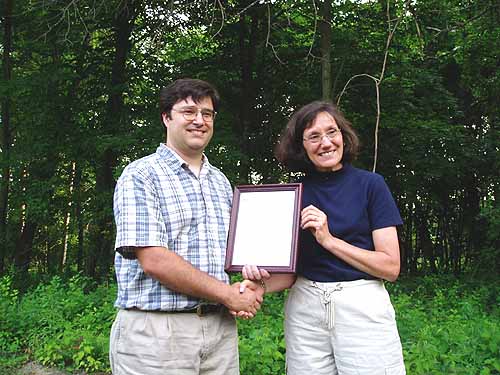
Dayton’s Bluff Community Council member
Jacob Dorer receives a Certificate of Recognition for his volunteer
work in local parks. Photo by Karin DuPaul
|
Jacob Dorer and Dennis Thompson were honored for
their volunteer work for parks and trails by the Friends of the Parks
at their annual meeting on June 30.
Jacob has volunteered since he was a youngster growing up
in Saint Paul. His Boy Scout Troop had annual clean-up events at Kasota
Pond, and helped develop a bicycle campground in Great Bluffs State
Park in southern Minnesota.
His work on the Dayton’s Bluff Community Council was a way
to get more involved in his neighborhood. He chaired the Greenspace,
Arts and Culture committee and wrote guidelines that helped ensure that
public and private green spaces were preserved and maintained.
He secured a pilot grant of $1,000 for Buckthorn removal
from private property in Mounds Park. He recruited volunteers,
organized a training session, and canvassed the area of 800 homes
notifying residents of buckthorn infestations.
Jacob has participated in the annual April parks cleanup
day in Mounds Park and helped in the cleanup of the Bruce Vento nature
sanctuary and with the regular parks invasive burdock and sweet clover
removal. He organized a garden tour for the Mounds Park neighborhood
and the prairie area planting along Mounds Boulevard, and helped with
the removal of buckthorn from the oak savanna area of Mounds Park.
Dennis Thompson has been an active member of the Friends
of Swede Hollow Park for the last three years and has helped in guiding
the restoration of Swede Hollow’s native vegetation. He helped direct
planting locations to ensure a naturalistic planting and to water and
care for the seedlings.
He was a member of the Great River Greening Steward Pilot
Project for Swede Hollow Park. He helped organize the event with the
students and teachers at Cleveland Middle School and the Friends of
Swede Hollow. After time in the classroom, 60 students participated in
the hands-on removal of invasive species.
Dennis was very involved with the Bruce Vento Trail
Connection. He was on the design committee representing both Friends of
Swede Hollow and the St. Paul Bicycle Advisory Board. He supported
alternatives that provided a good bicycle and pedestrian connection
from the East Side to downtown. When a final design was agreed upon,
both a short term and long term solution for the trail alignment was
identified. Construction will begin the fall of 2004 with completion in
the spring of 2005.
Dayton’s Bluff is blessed with these very active park and
trail volunteers.
Other volunteers honored were Grit Youngquist for her work
with Friends of Lilydale Park and Cliff Timm for his work in promoting
fishing at lakes in Ramsey and Dakota Counties.
Important
phone numbers for Dayton's Bluff residents to know
Schools
+ Dayton’s Bluff Elementary School (651) 293-8915
+ American Indian Magnet School (651) 778-3100
+ World Cultures Magnet School (651) 778-3200
+ Parkway Elementary School (651) 293-8845
+ Metropolitan State University (651) 793-1200
+ Eastside Lutheran School (651) 774-2030
+ St. John Lutheran School (651) 776-8861
+ Trinity Catholic (651) 776-2763
Organizations
+ Dayton’s Bluff Community Council (651) 772-2075
+ The Portage for Youth (651) 772-8674
+ Dayton’s Bluff Neighborhood Housing Services (651) 774-6995
+ Merrick Community Services (651) 290-4755
+ Southern Minnesota Regional Legal Services & Housing Alliance Law
Office (651) 771-9323
+ Upper Swede Hollow Neighborhoods Association (651) 771-2659
+ Caroline Family Services (651) 772-1344
+ Community Design Center (651) 228-7073
+ Block Clubs, Karin DuPaul (651) 772-2075
Recreation Centers
+ Dayton’s Bluff Recreation Center (651) 793-3885
+ Margaret Recreation Center (651) 298-5719
Emergency
Services
+ First Call for Help 211 (now dial only three numbers)
+ Police (651) 291-1111 or 911 in emergencies
City Council Members
+ Kathy Lantry, Ward 7, (651) 266-8670
+ Dan Bostrom, Ward 6, (651) 266-8574
Theater
+ Mounds Theatre (651) 772-2253
Newspaper
+ Dayton’s Bluff District Forum (651) 772-2075
A
Norwegian student's view of life in Minnesota
By Anette Hanssen of
Stavanger, Norway
I was born in Norway in a town called Stavanger, which is
located on the southwest side of the country by the coast. My
mum’s house is only about a quarter of a mile from the ocean. So
how did I end up in Minnesota? Well, it all started when I met
this guy… He was in the Marines, and stationed at NATO
headquarters. To make a long story short, when he was moving to
Minnesota to start at the U of M, I decided to come with.
Through a search on the Internet I found Metropolitan
State University, and after some months doing necessary paperwork, I
was accepted into the First College program. I started school in
January of 2003. During the first part of the semester I took the
bus. It was kind of interesting at first, observing people and
places on the way. That’s also when I found out how cold the
winters are here. To get to the St. Paul Campus from my
apartment, I had to take three different buses, with a 15-minute
“layover” in downtown Minneapolis and downtown St. Paul. Total
travel time was one hour and 30 minutes to two hours one way. By
March I had a car, and I have not taken the bus again.
Daily life in Norway is filled with American influence.
English or American words and names of things are as common as
Norwegian is. All kids learn English from the time they are 8
years old, but they might know a lot already before then because of all
the foreign computer games and cartoons.
Furthermore, our movie theaters and TV stations have
pretty much the same programs as they do here in the U.S. One of
the things that surprised me when I got to the U.S is the fact that I
have been here two years already, and still have not seen a single,
famous person yet! I also went to Hollywood and Beverly Hills,
but all I saw there were high fences, bums and hookers. So I
realized, that most of what we in Norway see of the States is the “rich
and famous” part of it, not the average American. The average
American is a normal person, just like us.
A more “close to home” observation I did have the first
weeks I spent in the Twin Cities, was all the squirrels
everywhere. We have them also, but they are rarer, and they
always hide in the woods. A geographic observation is the lack of
coastline and mountain ranges.
A sentence I tend to say a lot is: “that’s different from
home.” It just falls naturally to compare and contrast things I
see and do here in the United States with what I am used to from
Norway. A phenomena I find amusing is the “beep” sound heard on
the TV, movies, or radio when someone uses a swear word. That is
something we do not have.
One of the expectations I had of Minnesota was that there
were many Norwegians there. After being here for a while I realize that
is a truth with modifications. I would meet somebody, and during
the conversations it will come up that I am Norwegian, whereas the
other person often got exited, saying “Me too! My great
grandmother came here from Norway in 1890.” At first I was
surprised that their ancestor’s cultural identity was of so high
importance to them, even though this was a 100 years ago, and they do
not know the language anymore. But now, after being here for 2
years, I understand better.
I am so used to being from a homogenous nation, that
cultural identity has not been an issue. There is, for the most
part, only one cultural identity in Norway. We all come from the
same cultural background, celebrate the same holiday, have the same
religion and talk the same language. An example of how this was
different for me in Minnesota happened this Christmas. I was
working on arranging a Christmas event at the university, with a group
of students, and we were talking about the layout of the posters.
I said something like “Let’s call it Christmas Celebration,” thinking
everybody would agree. Well, they didn’t. They told me we
could not call it Christmas, because not everybody is Christian
here. I was surprised; I did not think of that. I am not a
very religious person, but I celebrate Christmas because it is a family
event. So anyway, we ended up calling the event Holiday Night,
and I learned an important lesson.
Many people I have met here in Minnesota think Norway is a
really cold place. When I get that question I always explain to
them that we have a lot milder winters than people in Minnesota are
used to. Norway is located 20 degrees closer to the North Pole
than the Twin Cities, but we have the Gulf Stream coming up from the
Mexico area to the North Sea to warm us up. Therefore, the winter
temperature by the coast is between 32 and 50 degrees Fahrenheit.
Our summers, though, are colder than in Minnesota, with temperatures
between 50 and 75 degrees Fahrenheit.
Another part different from home is the amount of people
there are here. Stavanger, Norway is the fourth biggest city in
Norway, with 110,000 inhabitants. Norway has a total of 4.5
million people. Any event, park, supermarket or tourist
attraction is small in size. If there are more than 1000 people
present at anything, it is a very big event. Here in the United
States, I have to stand in line for everything. When I was in
Disneyland, one hour in line for each attraction seemed to be
commonplace. I think there must have been more people in that
park than inhabitants in Stavanger! Furthermore, the size of the
stores here, and the amount of products there is to buy, is a lot more
than I am used to. A normal grocery store at home is maybe 10% of
the size of a Cub.
Something I have noticed since moving to Minnesota is that
people put great importance on getting married, especially if you are a
female and done with college. When I came here I had been
together with my boyfriend for one year, and I had not thought about
marriage at all. The first time I talked to his mother, she asked
me when we were planning to get married. Also, a few weeks later,
we went out to a dinner with some friends of his. Later that
evening one of his friend’s wife came up to me and asked me how long we
had been together, and if he had proposed yet. When I said no,
she was surprised, saying that she and her husband had gotten engaged
less than a year after they met. My experience is that the
Norwegian culture is more relaxed on this matter. It is very
common for people to live together for a few years before they get
engaged. Also, the average age for women in Norway getting
married is 27, while it seems like it is lower here. In February
of this year I did get engaged, after living together with my boyfriend
for 1.5 years. That is when I realized the second big “craze”
about marriages: the size of the diamond on the ring.
Are
you registered to vote? Here's how!
By Jim McDonough, Ramsey
County Commissioner
Haven’t we all wondered if our one vote in an election
really matters? Remember the 2000 presidential election and how
the result came down to just a few hundred votes. You vote does
count and it is your right as an American - a privilege not
shared by many people in other countries. So it is important to
vote. As a citizen, and an elected official I urge all legal voters to
learn about the issues and the candidates, and to exercise this
precious right each election.
To vote in the September primaries and the November
election, you must be a registered voter.
You will need to register to vote if you have:
• Never voted before;
• Not voted in the last four years;
• Moved since last voting; or
• Changed your name since last voting.
You may register to vote at your polling place on Election
Day. To do so, you must bring ONE of the following documents:
1. Minnesota driver’s license, learner’s permit or Minnesota
identification card (or a receipt for any of these documents) that
includes your current address.
2. Notice of late registration mailed to you by Ramsey County Elections.
3. Prior registration at another address in your precinct.
4. Oath of a registered voter in your precinct who can vouch for your
residence in this precinct.
You may also register to vote in person or by mail at the
Ramsey County Elections office or at any city or town hall in Ramsey
County. In person and mail registration ends for the state primary on
August 24 and for the state general election on October 12.
Already Registered? Be an
Election Judge
Election Judges are a vital part of ensuring an accurate
election result. Any U.S. citizen who is eligible to vote in
Minnesota can serve as an election judge. The position pays for both
the training time and the hours worked on election days. Employers are
required by law to excuse people from work to act as election judges.
With 178 polling places to staff countywide for 15-16
hours, Ramsey County elections managers need 1800-2000 election judges.
It’s important to remember that you can get time off from
work without loss of salary to serve as an election judge. We encourage
people to take advantage of this opportunity and we particularly are
interested in people who are bilingual and speak Hmong, Spanish,
Russian, or Somali.
Precinct election judges serve either the whole day (6:00
a.m. to 9:00 p.m.) or may choose to serve half-days (6:00 a.m. to 2:00
p.m. or 2:00 p.m. to 9:00 p.m.). Salaries for St. Paul precinct
election judges are $8/hr. Other cities in the county pay similar
amounts.
High school students who are 16 years or older are also
eligible to serve as election judges with the approval of their parents
and school officials.
Basic Qualifications to be an
Election Judge are:
United States citizen; at least 18 years old; eligible to vote
in Minnesota; able to read, write, and speak English.
If you are interested in being an election judge, call
651-266-2171 or go to: http://www.co.ramsey.mn.us
and click on elections.
The
right to vote means much more when it has to be earned
By Nachee Lee, Executive Director, Dayton’s Bluff Community
Council
As a new American I would like to encourage everyone to
get out there and vote. What does the right to vote privilege
mean to me? To some, it might not mean much or not be very
important. But for me, it was the most powerful privilege I
received since becoming a U.S. citizen.
Many people might not realize how important it is to be a
citizen that automatically earns the right to vote. For people
like me, I had to go through a series of tests and interviews before I
could earn my right to vote.
First, it cost me a great deal of money for the
application, photos, fingerprints and citizenship class. Second,
I had to pass a citizenship exam and oral interviews with the INS
people where everything about me was revealed and recorded.
Third, I had to swear in front of a judge and many people. Last and
finally, I had to wait for thirty days before I received my citizenship
certificate. This whole process took me more than a year
before becoming a US citizen and earning my voting privilege. The
process was not just long but also frustrating and mind racking.
Since I came to this country the best thing that ever
happened to me was earning the right to vote. I find this to be
the most and only equal opportunity an individual over the age 18 can
have. in this country. One great reason for taking advantage of
this right is that it took lives, sacrifices, and a great leader like
Dr. Martin Luther King, Jr. helping to make it happened for everyone.
Be part of this democratic privilege and VOTE.
Dancer
Lydwine Sisson is bringing burlesque to the Mounds Theatre
Take notice Dayton’s Bluff. Like it or not,
burlesque is coming to town.
After being informed of an upcoming August 14th event to
be held at the restored Mounds Theatre, the Forum dispatched me to the
dwelling of Ms. Lydwine Sisson, (aka – “Darla”) whereby I was enlisted
to learn more about this experienced dancer.
“My dream is all coming true, to perform at the Mounds
Theatre,” Lydwine said. “This show is a one of a kind. It’s going to
make news. It’s going to put Dayton’s Bluff, and the Mounds Theatre on
the map.”
This rollicking revue, many years in the
making, and entitled ‘Do You Remember Darla?’ will also include the
gifted “Darla Dames” consisting of Bashful Bernadette, Little Missy,
and Lovely Leilani. These girls I assure you, are very talented
in their own right when it comes to strutting their stuff. The
dance numbers will be performed to a variety of eclectic music, from
Tom Waits to Etta James.
There will also be guest performances by local comedian
Vicente Luna, dancer Bobby Wilson and a group of flame twirlers called
“Illumination Troupe.” All this can be experienced for only $7;
$5 if you are a senior.
If you’re worried about nudity, breathe easy, for Lydwine
describes this revue as “your mama’s burlesque.”
“Dancing is art…it is my means of expression. I let my
body and my feet do my talking. If you want to find out what I mean,
you’ll have to come down and see the show,” Ms. Sisson said with an
esteemed grin.
This special burlesque is a performance to commemorate the
20th anniversary of the closing of the original Alary’s nightclub on
Wabasha St. in 1984. Darla’s act was the final performance thither, and
indeed, she seems attached to her memories within its confines. During
her glory days at Alary’s, she was known and loved by all who
frequented this burlesque getaway.
“I’ve been looking for the people who used to know me
then; who used to come faithfully. I need to get to them for they’ll
remember Darla,” Ms Sisson said, wistfully.
Alary’s I learned, was “the one and only striptease
nightclub in downtown St. Paul” offering the traditional fare of
burlesque, tastefully undertaken, and never presenting more than
pasties and g-strings.
“We made real costumes then,” Lydwine said. “We knew how
to put on a real show, not what one may find today. We do a classy
burlesque. It was dance orientated, costume orientated, it was how you
took off each article of clothing. You don’t see this anymore; it’s a
lost art. There’s not many around who can do it anymore.”
After some reflection at her small desk with a picture of
a wolf above her, she went on. “I’ll continue to dance as long as I’m
alive. I don’t know any dancers my age anymore. I feel as if I’m in a
time warp. God knows for some reason. I guess to bring this unspoken
message: if you take care of yourself, you can actually be a productive
person. You can live a happy, healthy, purposeful life.”
With this, Lydwine arose and walked about the living room
of her small dwelling before telling me more. “I’ve overcome some
personal difficulties. Some people manage to pull themselves out.
Sometimes you find this spirituality you thought you never had. My
dance is unspoken. I want to say ‘you can survive.’ I’ve had every kind
of loss you can name or think of. My music and dancing were even lost,
but happily I found them again.”
This revue will certainly be a showcase for our own Mounds
Theatre, and I recommend every one of my loyal readers to attend.
Lydwine also wanted to point out that all of the proceeds of this event
will go toward the continuing restoration of the theatre.
“I want to pack the house,” Lydwine says.
And indeed, if sales for this Saturday, August 14th event
are robust enough, she may offer a second show on the evening of the
15th. In the days ahead Darla will be performing at First Avenue in
Minneapolis. And in the future if any venues are interested in having
her perform, for parties or gatherings of any kind, she may be
contacted at lydwinesisson@msn.com. For all the data about the show,
including advance ticket sales, call the theatre at (651) 772-2253, or
visit www.moundstheatre.org.
Ms. Sisson, a ’95 grad of Metropolitan State University,
and a Dayton’s Bluff resident since 1997, demonstrates her versatility
by creating her own costumes, and producing, directing, and
choreographing all of her events.
Lydwine’s daughter Bernadette, besides being one of the
Darla Dames, is also responsible for the photography and all the
promotional material for the show. Bernadette got an early start in
show biz. Darla was pregnant with her that last night she danced
at Alary’s.
On a personal note, I was treated to yet another benefit
from this often difficult job: that of a private dance behind closed
doors, if only for a preview performance. And though I shall
disclose no details lest I ruin anyone’s surprise, I truly may vouch
for Lydwine’s talent.
In closing, Darla said with a smile – “Dancing is what I
love to do. It’s all about the bump and the grind.”
|